Technology Development
Automated Experimentation & Genome-Wide Analysis
At the center of our technology platform are the ALEbots — automated systems that culture microbes and run adaptive laboratory evolution around the clock, turning a slow manual craft into a high throughput engineering and discovery tool. Every experiment feeds our mutation-analysis pipelines and ALEdb, building an unmatched record of how genomes change under selection. We close the loop with genome-scale models, omics analysis, and computational algorithms that connect genotype to phenotype and turn that data into predictions.

Technology Development
Automated Experimentation & Genome-Wide Analysis
ALEbots automate adaptive laboratory evolution around the clock, turning a slow manual process into a high-throughput tool for engineering and discovery. Every experiment feeds our mutation-analysis pipelines and ALEdb, while genome-scale models and omics connect genotype to phenotype and turn data into predictions.
Our Approach
Automating Experimentation and Creating Computable Models
Platforms that automate evolution and enable prediction
Evolution experiments used to be limited by how long a person could keep pipetting. We removed that limit, and freed our researchers from the repetitive labor that came with it. Our platforms culture and evolve microbial populations continuously for months, without manual passaging or sampling. Instruments, informatics, and models work as one system, making experiments faster, more reproducible, and easier to share across labs.
Evolution experiments used to be limited by how long a person could keep pipetting. We removed that limit, and freed our researchers from the repetitive labor that came with it. Our platforms culture and evolve microbial populations continuously for months, without manual passaging or sampling. Instruments, informatics, and models work as one system, making experiments faster, more reproducible, and easier to share across labs.

ALEbots: automation that cultures in high-throughput and runs around the clock
Purpose-built robotics turn microbial culturing and evolution from a manual craft into a throughput problem. ALEbots culture 40 or more populations simultaneously for months on end, adjusting conditions in response to live data and enabling protocols and selections beyond what a person could run by hand.
Automated Cultivation Platforms - ALEbot

ALEbots: automation that cultures in high-throughput and runs around the clock
Purpose-built robotics turn microbial culturing and evolution from a manual craft into a throughput problem. ALEbots culture 40 or more populations simultaneously for months on end, adjusting conditions in response to live data and enabling protocols and selections beyond what a person could run by hand.
Automated Cultivation Platforms - ALEbot
Systems-level measurement, standardized — anchored by genomics and ALEdb
We measure whole systems, not single variables — genomes, transcripts, proteins, secreted metabolites, and growth behavior on every strain. Standardized pipelines and ALEdb keep each measurement tied to the condition that produced it, so results stay comparable across experiments and organisms.
Omics, Analysis, and Data Infrastructure

Systems-level measurement, standardized — anchored by genomics and ALEdb
We measure whole systems, not single variables — genomes, transcripts, proteins, secreted metabolites, and growth behavior on every strain. Standardized pipelines and ALEdb keep each measurement tied to the condition that produced it, so results stay comparable across experiments and organisms.
Omics, Analysis, and Data Infrastructure
Genome-scale reconstructions and analysis software we develop and release
A digital twin of a cell is only as good as what it's built from. Ours are reconstructed bottom-up, gene by gene, from genome annotations, extended to include the cost of making proteins, and searched by algorithms for designs worth building and new biology worth finding.
Computational Modeling Tools
Genome-scale reconstructions and analysis software we develop and release
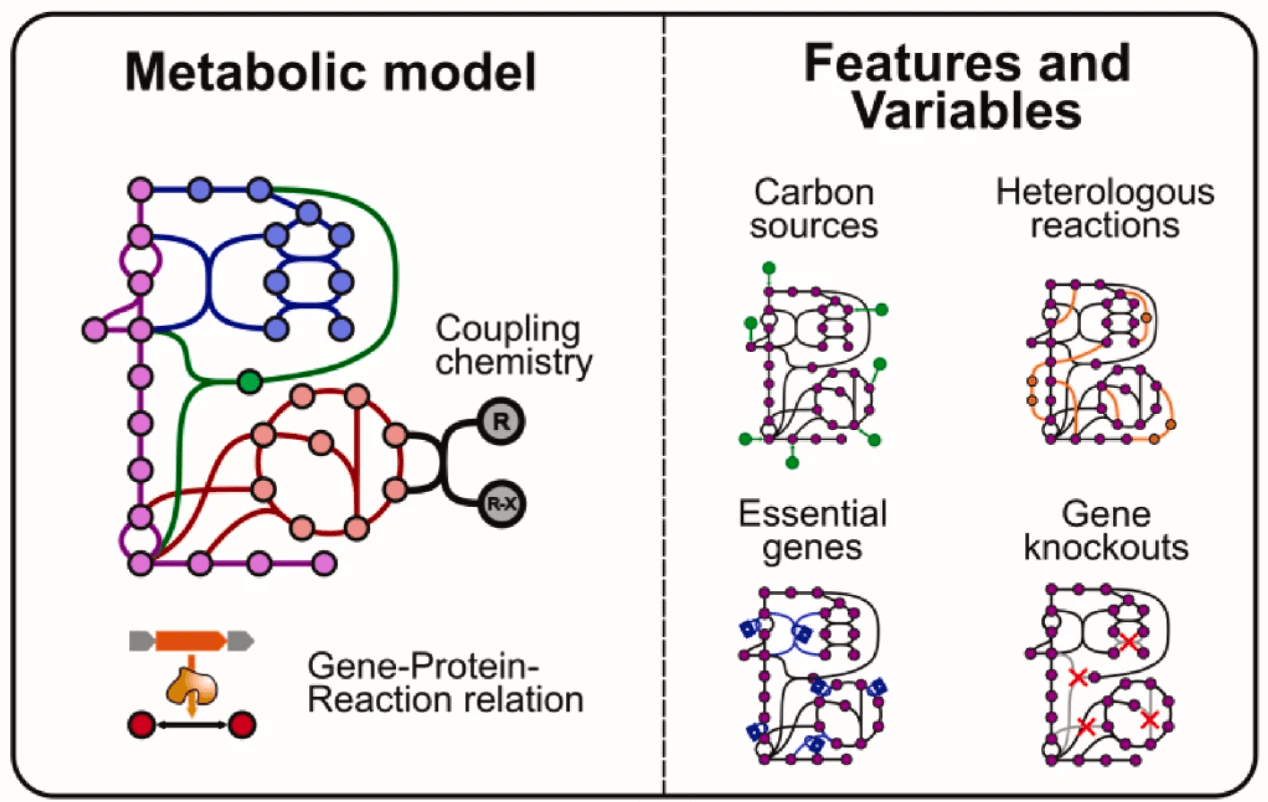
A digital twin of a cell is only as good as what it's built from. Ours are reconstructed bottom-up, gene by gene, from genome annotations, extended to include the cost of making proteins, and searched by algorithms for designs worth building and new biology worth finding.
Computational Modeling Tools
Lab Locations
San Diego, CA
University of California San Diego
Copenhagen, Denmark
Technical University of Denmark
Get in Touch
In accordance with applicable Federal and State law and University policy, the University of California does not discriminate, or grant preferences, on the basis of race, color, national origin, religion, sex, disability, and/or other protected categories. More information about Proposition 209 can be found here. More information about the University of California Anti-Discrimination Policy can be found here. Initiatives are open to all eligible members of the UC San Diego campus community and does not discriminate against, or grant preferential treatment to, any individual or group on the basis of race, color, national origin, religion, sex, disability, and/or other protected categories.
©2026 by Adam Feist and UC San Diego. All rights reserved.
Lab Locations
San Diego, CA
University of California San Diego
Copenhagen, Denmark
Technical University of Denmark
Get in Touch
In accordance with applicable Federal and State law and University policy, the University of California does not discriminate, or grant preferences, on the basis of race, color, national origin, religion, sex, disability, and/or other protected categories. More information about Proposition 209 can be found here. More information about the University of California Anti-Discrimination Policy can be found here. Initiatives are open to all eligible members of the UC San Diego campus community and does not discriminate against, or grant preferential treatment to, any individual or group on the basis of race, color, national origin, religion, sex, disability, and/or other protected categories.
©2026 by Adam Feist and UC San Diego. All rights reserved.