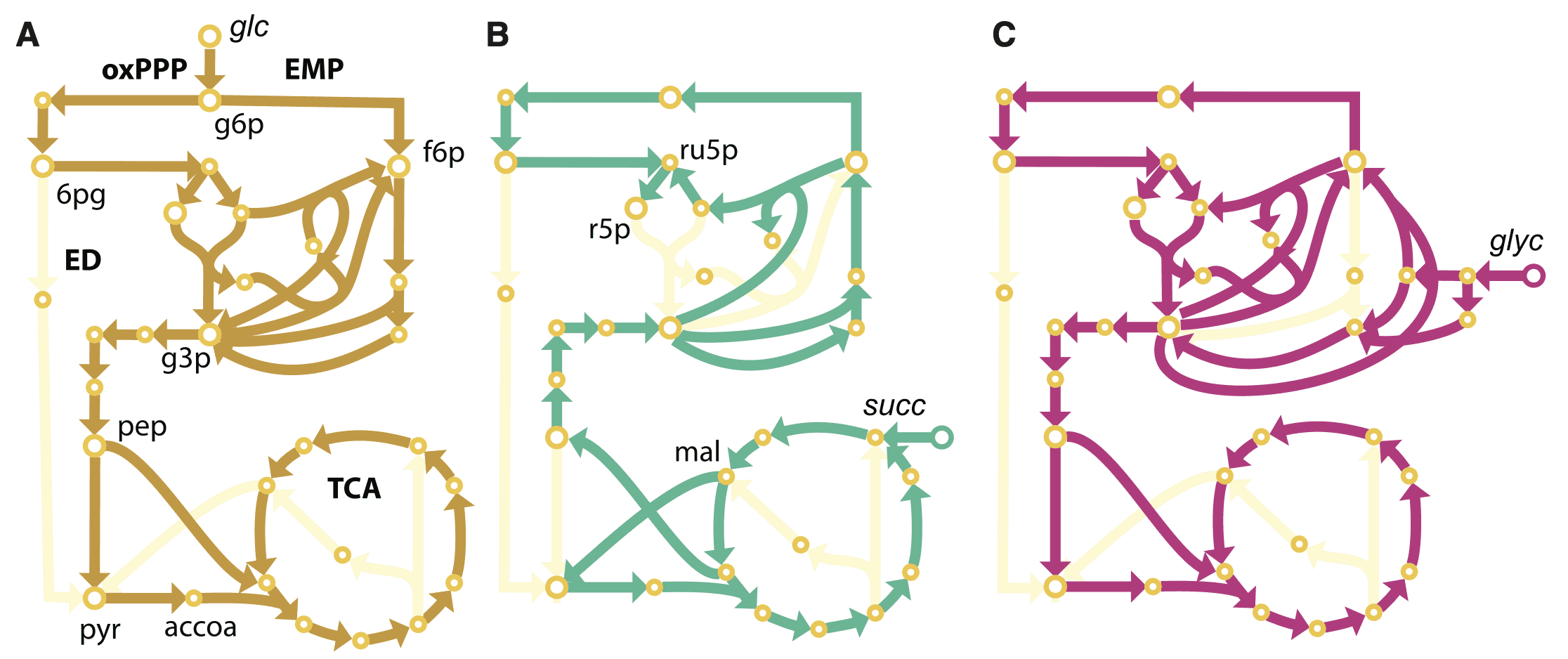
Computational modeling will be essential for microbial engineering and discovery going forward, and reconstruction is where it begins. Building a genome-scale model means going through an organism's annotated genome gene by gene, assigning biochemical function, and assembling the resulting reactions into a stoichiometrically consistent whole that a computer can interrogate. Historically this was slow, manual, literature-intensive work, and it was what separated a model that predicts from one that merely describes. Much of the process is now automated, building off previous pioneering efforts, but the curation step remains fundamental. We extend genome-scale reconstructions into metabolism-and-expression models that account for the cost of synthesizing the proteome itself, so the simulated cell has to pay for its own machinery, and we develop the models and the constraint-based toolboxes that run simulations on them. On top of that foundation sit the strain-design algorithms that search across possible genetic interventions for combinations that steer a cell toward a target phenotype. That search matters because the space of possible designs is far too large to explore by intuition, and because a good algorithm provides the context behind a design rather than only the design itself.
The same models are how we make measurements interpretable. Our integration pipelines map transcriptomics, proteomics, and metabolomics data onto model scaffolds, so a dataset becomes a statement about metabolic flux and resource allocation rather than a list of genes that changed. In this way, models routinely surface new biology, since the places where a cell's measured behavior departs from what its own reconstruction permits are precisely where unknown function is hiding. That infrastructure now serves machine learning as well. Our modeling capabilities enable feature pipelines and benchmark datasets that put our mutation, expression, and simulation records into the standardized form statistical and AI methods require, including computed quantities such as predicted fluxes and proteome costs that carry mechanistic information no sequence-based feature can supply. All of it is released as documented, open-source models and code, and the tools built here are used well beyond our own group, which is the point of building them.


