Predictive Cellular Modeling

Predictive Cellular Modeling

Genome-scale models as design tools, explanations, and feature generators

Genome-scale models as design tools, explanations, and feature generators

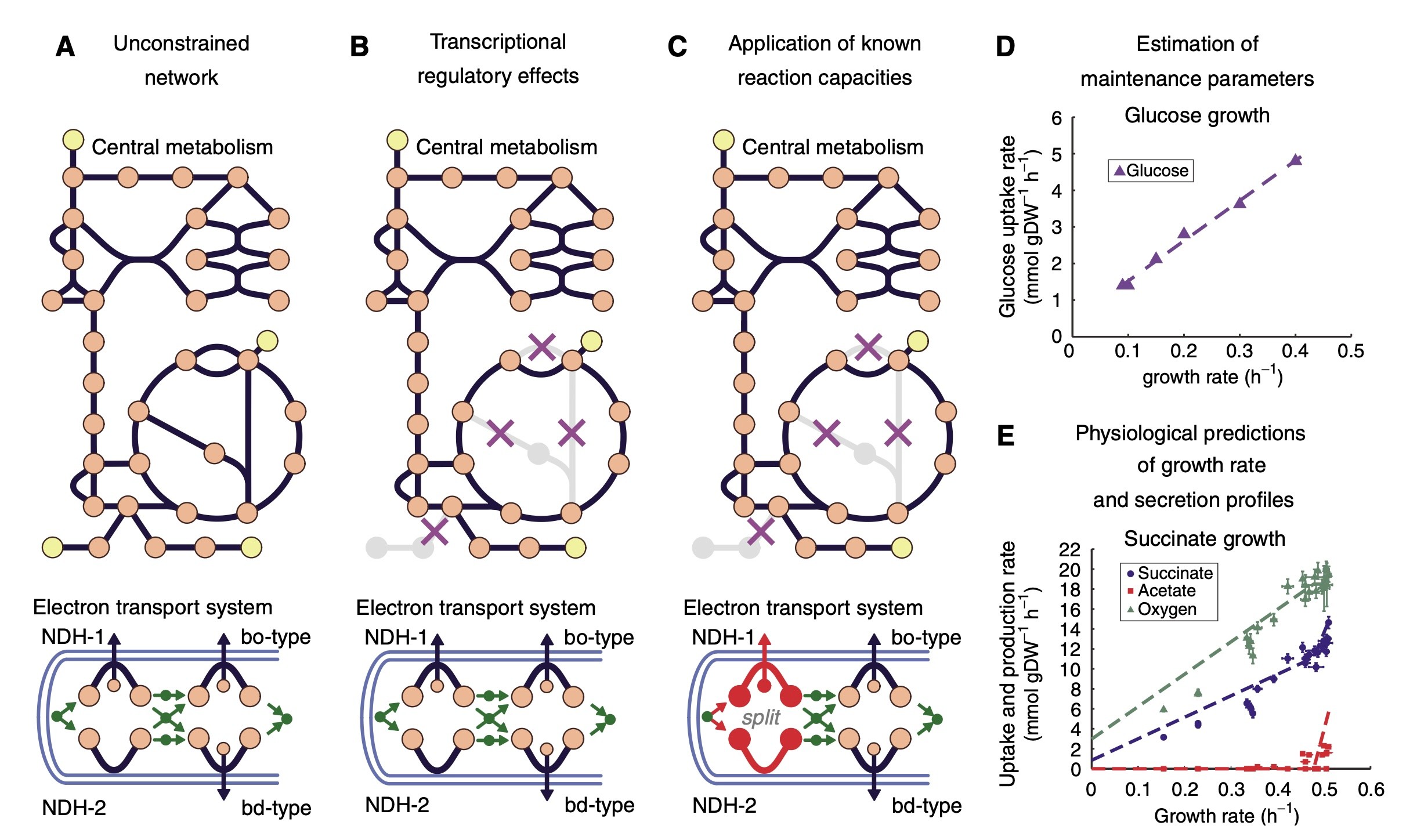
Genome-scale models, or digital twins, are reconstructed from a genome rather than fit to any single dataset, which is what lets them predict rather than merely describe. We use them for achievable growth rates, product yields, expression states, and secretion phenotypes before a strain has been built — so experiments start from a specific expectation rather than a hunch about what might work. Prediction is also a design tool: simulations tell us which knockouts, insertions, and media shifts should produce the physiology we're after and, just as usefully, which ones will not, saving construction effort on designs the cell cannot support. And because the reconstruction is genome-based, validated predictions transfer — the same twin can be rebuilt for another organism or reparameterized for a new set of process conditions.

Models are equally valuable after the experiment, as explanations. When a strain grows faster, secretes more, or tolerates a stress it previously couldn't, we use the model to work out what changed at the level of metabolic flux, proteome allocation, and the expression costs the cell is paying — turning a measured phenotype into a mechanistic account. That framework is what makes multi-omics data interpretable: transcript, protein, and metabolite measurements gain meaning when read against what the model says the cell can and cannot do. We then close the loop in the other direction, testing predictions against evolved and engineered strains and correcting the twin wherever it falls short, because a failed prediction localizes exactly which piece of biology is missing or wrong. The simulations themselves become data as well — computed fluxes, proteome costs, and predicted capabilities serve as mechanistic features for machine learning, giving statistical models the physiological context that sequence alone cannot provide.
Engineering evolution through automation

Lab Locations

San Diego, CA

University of California San Diego

Copenhagen, Denmark

Technical University of Denmark

Get in Touch

Follow Us

In accordance with applicable Federal and State law and University policy, the University of California does not discriminate, or grant preferences, on the basis of race, color, national origin, religion, sex, disability, and/or other protected categories. More information about Proposition 209 can be found here. More information about the University of California Anti-Discrimination Policy can be found here. Initiatives are open to all eligible members of the UC San Diego campus community and does not discriminate against, or grant preferential treatment to, any individual or group on the basis of race, color, national origin, religion, sex, disability, and/or other protected categories.

©2026 by Adam Feist and UC San Diego. All rights reserved.

Engineering evolution through automation

Lab Locations

San Diego, CA

University of California San Diego

Copenhagen, Denmark

Technical University of Denmark

Get in Touch

Follow Us

In accordance with applicable Federal and State law and University policy, the University of California does not discriminate, or grant preferences, on the basis of race, color, national origin, religion, sex, disability, and/or other protected categories. More information about Proposition 209 can be found here. More information about the University of California Anti-Discrimination Policy can be found here. Initiatives are open to all eligible members of the UC San Diego campus community and does not discriminate against, or grant preferential treatment to, any individual or group on the basis of race, color, national origin, religion, sex, disability, and/or other protected categories.


©2026 by Adam Feist and UC San Diego. All rights reserved.