Evolutionary Engineering

Evolutionary Engineering

Designing selections that make evolution produce what we want

Designing selections that make evolution produce what we want

Evolutionary engineering is only useful if you can aim it. Aimed well, it is a remarkably general problem solver: given a clearly defined problem — a strain that grows too slowly, a substrate it won't consume, a compound it can't tolerate — we can more often than not design a selection that overcomes it. The central design problem is coupling the phenotype you want to the fitness the cell will be selected for, so that the population's own selfish improvement produces your objective. We build those couplings deliberately, then engineer the conditions that enforce them: nutrient limitation, stress ramps, and stepwise environmental challenge that escalates as populations adapt. Alongside the selection itself, we tune the raw material evolution has to work with, adjusting mutation supply and population structure to control how much diversity is available at any moment. Every campaign runs as parallel, independent lineages, because a mutation that appears once is an anecdote and a mutation that appears in ten separate populations is a rule. Where selection alone won't get there, we combine it with rational design — targeted genetic edits made before, during, and after the selection to open routes evolution would otherwise never find.

The same pressure that builds strains also stress-tests them. We put wild-type and production strains under prolonged selection to learn what a genome does when left alone with an objective of its own: what drifts, what breaks, and which engineered functions are actually retained over hundreds of generations. That tells us where a production strain is fragile long before a process does, and it tells us how to design selections that hold a phenotype in place rather than letting it erode. Because these experiments run at scale and under defined conditions, they also generate something beyond the strains themselves — dense, standardized growth and fitness records tied to specific genotypes. We design experiments to produce data that is machine-learnable from the start, so the results feed statistical and machine learning analysis in structured data formats we build and populate rather than sitting in a supplementary table.
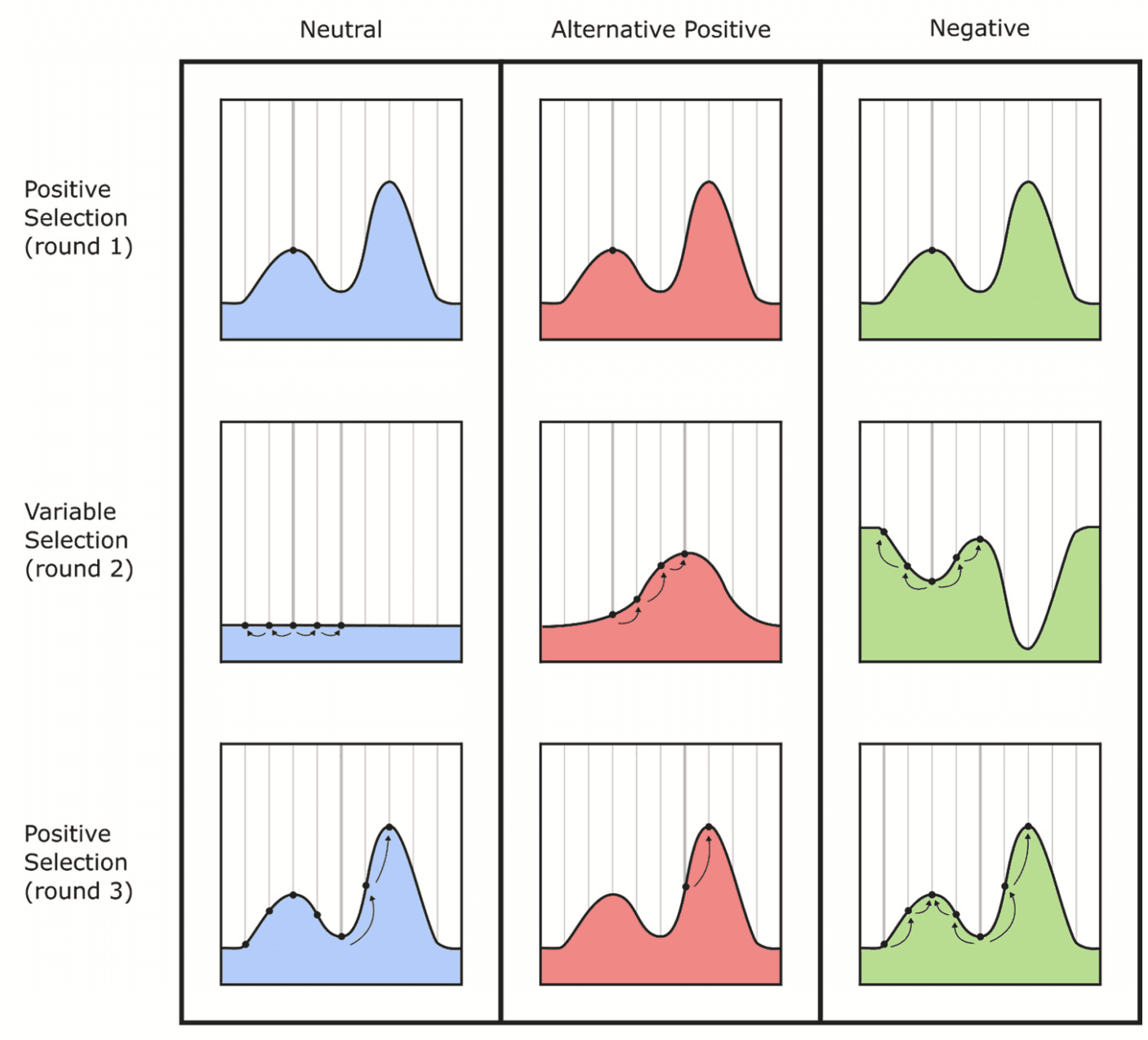
Changing the selection to escape a local optimum. A population stuck on a lower fitness peak can be freed by interrupting positive selection with a neutral, alternative, or inverted regime, reshaping the landscape so that resuming selection sends cells toward the higher peak. Carpenter et al., Metab Eng Commun 17:e00227, 2023.

Changing the selection to escape a local optimum. A population stuck on a lower fitness peak can be freed by interrupting positive selection with a neutral, alternative, or inverted regime, reshaping the landscape so that resuming selection sends cells toward the higher peak. Carpenter et al., Metab Eng Commun 17:e00227, 2023.

Simulated versus experimental results with large and small passage sizes. Passage size and culture volume alone changed the fitness these experiments reached. Simulation lets us choose those parameters and optimize how a campaign is run. LaCroix et al., Appl Environ Microbiol 83:e03115-16, 2017.

Simulated versus experimental results with large and small passage sizes. Passage size and culture volume alone changed the fitness these experiments reached. Simulation lets us choose those parameters and optimize how a campaign is run. LaCroix et al., Appl Environ Microbiol 83:e03115-16, 2017.

Removing a strain's dependency on a costly supplement. Automated weaning ALE drops glycine to zero and selects for growth without it, recovering within days. Every evolved isolate carries a substitution in MetK, and the population holds many distinct variants of the same enzyme. Bushin et al., Nat Biotechnol, 2025. Method Developed in Guzmán et al., Mol Syst Biol 15:e8462, 2019.

Removing a strain's dependency on a costly supplement. Automated weaning ALE drops glycine to zero and selects for growth without it, recovering within days. Every evolved isolate carries a substitution in MetK, and the population holds many distinct variants of the same enzyme. Bushin et al., Nat Biotechnol, 2025. Method Developed in Guzmán et al., Mol Syst Biol 15:e8462, 2019.

Simulating scale-up before it happens. Automated passaging puts engineered strains through a relevant number generations (hundreds or more) of a production or therapeutic run, then sequencing reveals what the genome did along the way. Münkler et al., Metab Eng 85:159-166, 2024.

Engineering evolution through automation

Lab Locations

San Diego, CA

University of California San Diego

Copenhagen, Denmark

Technical University of Denmark

Get in Touch

Follow Us

In accordance with applicable Federal and State law and University policy, the University of California does not discriminate, or grant preferences, on the basis of race, color, national origin, religion, sex, disability, and/or other protected categories. More information about Proposition 209 can be found here. More information about the University of California Anti-Discrimination Policy can be found here. Initiatives are open to all eligible members of the UC San Diego campus community and does not discriminate against, or grant preferential treatment to, any individual or group on the basis of race, color, national origin, religion, sex, disability, and/or other protected categories.

©2026 by Adam Feist and UC San Diego. All rights reserved.

Engineering evolution through automation

Lab Locations

San Diego, CA

University of California San Diego

Copenhagen, Denmark

Technical University of Denmark

Get in Touch

Follow Us

In accordance with applicable Federal and State law and University policy, the University of California does not discriminate, or grant preferences, on the basis of race, color, national origin, religion, sex, disability, and/or other protected categories. More information about Proposition 209 can be found here. More information about the University of California Anti-Discrimination Policy can be found here. Initiatives are open to all eligible members of the UC San Diego campus community and does not discriminate against, or grant preferential treatment to, any individual or group on the basis of race, color, national origin, religion, sex, disability, and/or other protected categories.


©2026 by Adam Feist and UC San Diego. All rights reserved.